Saturday, July 30, 2016
Using Communication Skills to Enact Change
After reviewing The 7 Cs of communication I believe that the most important communication skills are to be clear and concise. Clarity is very important because you need the person who is listening to you to understand you point and understand that point. A speaker needs to be concise when addressing an audience especially when trying to prove a point and make others believe how important an issue is.
My own strength in communication comes from being clear and concise. I feel that I am a very clear communicator when it comes to speaking to others about early childhood education and what I believe to be the best for our young children. I am also very concise when I am speaking on the subject on early childhood education I make sure to stick to my point and explain my thinking.
What I need to work on in my communication skills my anxiety of meeting new people. I know that when I am speaking to new people I come off as a very confident person who appears to be professional and have it all together. Truth is I am freaking out on the inside. There are so many thoughts going on in my head about my insecurities it's amazing I can make sense.
References
Mind Tools. (n.d.). The 7 Cs of communication: A checklist for clear communication. Retrieved October 15, 2013, from http://www.mindtools.com/pages/article/newCS_85.htm

Wednesday, July 27, 2016
Social Media’s Influence on Policy Issues
When thinking about what social media site I would use
to help further the policy issue I would like to change, I would choose
Facebook first. This is because it is
what I used the most in terms of Social Media.
I have many people on my friends list that that are early childhood
professionals. We often post information
that is related to the field that we work in.
I would post about the policy change on my Facebook page. This would be good not only for my friends
that are in early childhood education but for my family and friends that have
young children. Then I would open a
Facebook page just for the policy issue itself.
I would then send out invites to other to like the page that has been
created. The one issue that I can see
this be a problem is that what if it does not reach enough people?
The
second page that I would use for social media would be Twitter. I would use Twitter in much the same way that
I would use Facebook. First making
tweets via my own page and then creating one for the policy change itself. The problem with Twitter is how limited you
are with what you can post on the site.
Social
Media is a good modern way to help spread the word about what you are doing and
to effect change. However, I honestly
think that nothing beats meeting people in person and networking your ideas to
others in the field. You never know if
you will meet the right person that will help you to effect change.
Saturday, May 7, 2016
Course Goals
As I start this new course, Dynamics of Early Childhood Policies and Systems, I have been asked to reflect on early childhood systems and policy. Also, three goals that will assist me in becoming an effective early childhood professional as I reach to achieve my goals.
1. A better understanding of other early childhood systems. I have gone on many interviews and have discovered that so many different early childhood programs are using many different early childhood systems. It is very difficult to say that I am well versed in all of them. Yes, I have heard of most of them before but to say I am an expert, not so much.
2. Interaction with other early childhood professionals in the field. I believe that there is no better way to work than to learn from those who have come before. I was fortunate to have found a mentor years ago that I now call friend. She taught me as an undergrad how to be a preschool teacher. Today as I work in an elementary school I find myself drawn to other fabulous teachers who are showing me the ropes what it is like to be an elementary school teacher.
3. Become better versed in early childhood and the politics behind it. As I member of NAEYC I have received many e-mails recently about this upcoming election year and how to vote based on which candidate will help early childhood education in the Untied States. This is something I have not thought about until the last year or so. Yes, I do believe that it is important to find the candidate that will push legislation to put more funding behind early childhood education.
I hope to learn more in this new course to help me to prepare for my bright future.
Jolene
1. A better understanding of other early childhood systems. I have gone on many interviews and have discovered that so many different early childhood programs are using many different early childhood systems. It is very difficult to say that I am well versed in all of them. Yes, I have heard of most of them before but to say I am an expert, not so much.
2. Interaction with other early childhood professionals in the field. I believe that there is no better way to work than to learn from those who have come before. I was fortunate to have found a mentor years ago that I now call friend. She taught me as an undergrad how to be a preschool teacher. Today as I work in an elementary school I find myself drawn to other fabulous teachers who are showing me the ropes what it is like to be an elementary school teacher.
3. Become better versed in early childhood and the politics behind it. As I member of NAEYC I have received many e-mails recently about this upcoming election year and how to vote based on which candidate will help early childhood education in the Untied States. This is something I have not thought about until the last year or so. Yes, I do believe that it is important to find the candidate that will push legislation to put more funding behind early childhood education.
I hope to learn more in this new course to help me to prepare for my bright future.
Jolene
Monday, April 11, 2016
Final Thoughts
As this latest course comes to a close I am reflecting on what I have learned and what helped me learn the most. During my coursework what connected with me the most was the media presentations from Shuan-Adrian and Marsha. The stories that hey presented were not different than the stories that I could read on paper however hearing them speak through the media presentations moved me. I could feel the emotions through the interviews that they provided for the media presentation. The true life experiences that these people lived through, people who are just like you and me.
I would have to say that there is little that surprised me throughout this course. The majority of my career I have worked with children who are culturally diverse. I have heard the hardships of families who are not in the majority. I have worked with the children who are learning English as a second language. I have worked with low-income families and children and have been one myself.
In this course it revived me to work harder in my professional career for the culturally diverse child, the low-income child, the underdog. I can use my professional connections and my everyday work to help children and families that otherwise may not have someone to give them a voice.
I would have to say that there is little that surprised me throughout this course. The majority of my career I have worked with children who are culturally diverse. I have heard the hardships of families who are not in the majority. I have worked with the children who are learning English as a second language. I have worked with low-income families and children and have been one myself.
In this course it revived me to work harder in my professional career for the culturally diverse child, the low-income child, the underdog. I can use my professional connections and my everyday work to help children and families that otherwise may not have someone to give them a voice.
Friday, March 18, 2016
The Interview Process
I have found that the interview process is going very smoothly for me. I have been able to contact both of the people that I am going to interview. If anything was the most difficult was coordinate times with my interviewees and myself. All three of us have very busy schedules between work, family and obligations. I found that both of my interviewees were very honored to be asked to be interviewed for the course project.
The course presentation is going well. At times I find it difficult to keep finding new articles to use for the bibliographies, however in the end after some time I always find what I am looking for. I have learned even more about the topic that I have chosen about children who are learning English as a second language than I ever knew before.
The course presentation is going well. At times I find it difficult to keep finding new articles to use for the bibliographies, however in the end after some time I always find what I am looking for. I have learned even more about the topic that I have chosen about children who are learning English as a second language than I ever knew before.
Friday, February 5, 2016
Course Project
The topic that I would
like to do is that of the challenges of teaching children English as a Second
Language. I believe that this is a very
important topic because school districts are having a difficult time in
assisting all children that enter their doors with varying home languages. The subtopic would be cultural challenges
related to teaching English as a language. There are challenges in teaching
children English as a second language while helping the child to succeed in the
grade that they are assigned too. I
already have two people to interview on the topic one is an English as a Second
Language teacher the other is a distinguished member of the community who has held many
positions in the local school district plus has help offices in local and
national organizations.
The reason that I have selected this topic is because I work as a teacher assistant helping children learn English as a second language. It is a job that I fell into by accident because I can speak both English and Spanish. It is important to me because when my children were younger we lived in Mexico and my children and myself had to learn Spanish as a second language. I understand the struggles of both being an adult learning a second language, a teacher teaching a second language and a parent watching their child learn a second language.
My initial beliefs about children learning English as a second language is that it is not only difficult for the child to learn the language it is difficult for them to learn the culture that goes along with that language at the same time. The children that I work with are mainly from Mexico and come to the USA with the Mexican culture intact. Many times children will ask me to explain holidays and customs that are part of the American culture. Many times they will look at me with puzzled faces trying to understand what seems to be strange to them like many Americans look at them and their customs a
Monday, August 17, 2015
Final Global Perspectives Blog
Resources that I believe our beneficial for the early childhood professional are anything that has been published by NAEYC. On the NAEYC website there is not only articles to read but also books that can be ordered on a vast range of early childhood topics. The NAEYC website is:
www.naeyc.org
I selected NAEYC because I always turn there first when in need of early childhood information.
My favorite inspirational quote about early childhood is:
"The first five years have so much to do with how the next eighty turn out" - Bill Gates
I selected this quote because nothing could be closer to the truth.
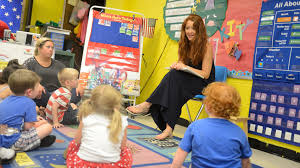
This is one of my favorite images that I selected when I see this image of the early childhood classroom I am at once transported to why I am passionate about early childhood education.
www.naeyc.org
I selected NAEYC because I always turn there first when in need of early childhood information.
My favorite inspirational quote about early childhood is:
"The first five years have so much to do with how the next eighty turn out" - Bill Gates
I selected this quote because nothing could be closer to the truth.
This is one of my favorite images that I selected when I see this image of the early childhood classroom I am at once transported to why I am passionate about early childhood education.
Subscribe to:
Comments (Atom)